
The short version
- Adults with ADHD describe keeping everyday tasks organised as a real, ongoing challenge, so a routine breaking says nothing about you.
- The strategies they report working are concrete ones, like set ways of doing things, other people, and reminders you can see.
- Pick a return point while the routine is going well. It’s the smallest version you’d still count.
- The day after a miss, do the return point and nothing else. Doing it next to someone can make it easier.
How a routine usually falls apart
Routines almost never end because you decide to stop. They break once, because of a trip, a cold or a late night, and then the break slowly turns into the new normal.
Sound familiar?
Getting back in starts to feel like it needs the whole routine plus a new plan. Maybe a new app, or a nicer notebook. That takes energy you don’t have today, so it moves to “next week”. The streak feels ruined, so somehow the routine doesn’t count anymore, and then there’s the guilt about that, which makes starting even harder. By the time Monday arrives, it’s been ten days instead of two.
Maybe you also know these:
- You’ve bought a new planner to “properly” restart, and it’s still in the plastic.
- You avoid the gym app because opening it means seeing the broken streak.
- You were doing so well for three weeks, and you can’t explain why it stopped.
- You’ve said “from Monday” so many times it feels like a joke.
If that’s you, you’re not bad at routines. You’re normal at them, and a bit harder on yourself than you need to be.
A lot of people with ADHD also notice that the routine they dropped was a pretty elaborate one. The more parts it has, the more there is to rebuild.
So the trouble is how big the way back has become. If rejoining means making a fresh plan, rejoining has to wait until you have the energy to plan. And everyone already knows “just get back on track”. The hard part is doing it.
What adults with ADHD say helps
When researchers ask adults with ADHD about daily life, the same thing keeps coming up.
The research bitAdults with ADHD say outside structure helps most
A review that pulled together 10 interview studies found that adults with ADHD describe organising and getting through everyday tasks as a real challenge, one that can also feel rewarding when it works. They build their own coping strategies to keep life in balance [1].
A later review of seven interview studies grouped the strategies adults with ADHD use into three kinds: set ways of doing things, people who encourage and help, and external aids for managing the day [2]. In a smaller study of 12 adults aged 21 to 38, getting into everyday activities depended on inspiration, support that made things easier, and a feeling of doing things together with other people [3].
The pattern is clear. Willpower and a better plan don’t do much. Things that live outside your head do: a fixed way of doing it, something you can see, someone next to you.
There’s also good news on the skills side.
The research bitLearning planning skills improved ADHD symptoms
In a trial with 88 adults with ADHD, a 12-week group therapy that taught time management, organisation and planning improved ADHD symptoms more than supportive therapy without those skills. A blind evaluator, the participants themselves and people close to them all reported the difference [4].
One missed day does less than you think
The research bitOne missed day barely matters (general study)
In a 12-week study, 96 volunteers each picked a daily habit tied to a fixed moment and rated every day how automatic it felt. Missing a single day didn’t really change how the habit formed [5]. This one wasn’t done with people with ADHD, and I couldn’t find an ADHD study on missed days, so treat it as a general hint, not a promise.
What I take from it: the real cost is the long gap that grows while you wait for a good moment to restart.
Choose your way back before you need it
Decide the way back while things are going well.
A return point is the smallest version of your routine that still counts. You pick it now, while things are fine, so that on a bad day there’s nothing left to decide.
- Evening tidy: put the dishes in the sink.
- Exercise: put your shoes on and walk to the end of the street.
- Journaling: write the date and one line.
- Morning planning: open your calendar while the kettle boils.
On the first day after a miss, you do the return point and that’s it. The full routine comes back when it comes back.
Try this
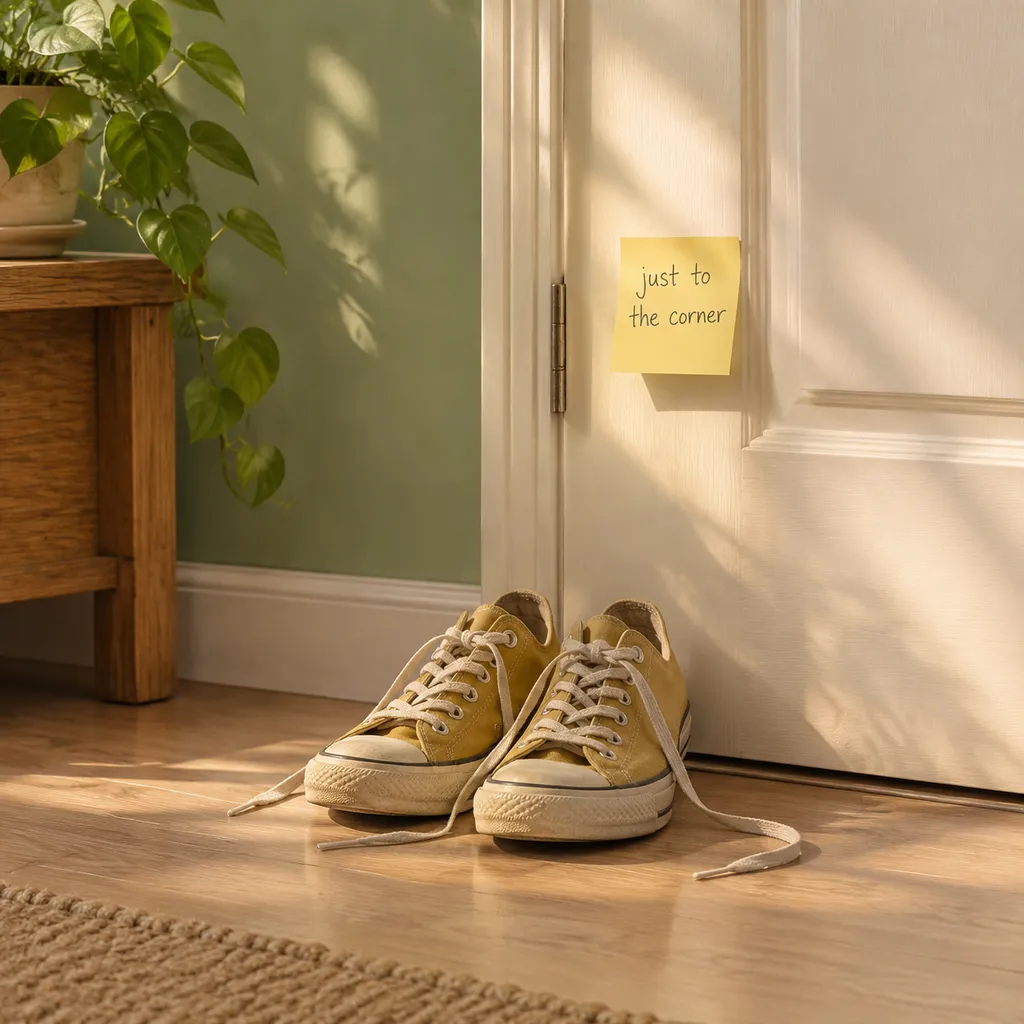
Write your return point as a sentence: “If I’ve missed my [routine], then at the next [moment] I’ll [smallest version].” For example: “If I’ve missed my evening walk, then after dinner tomorrow I’ll put my shoes on and go to the corner.”
Then put it outside your head. Stick it on the fridge, inside the journal cover, or make it your phone’s lock screen. And if it helps, tell one person: “I’m walking to the corner after dinner.” Doing the return point next to someone, or just with someone knowing, makes it a lot easier for many of us. Working next to someone has more on why.
Count comebacks, not streaks
Streak counters reward unbroken runs, so one miss feels like losing everything before it. If that feeling keeps you away, count something else, like how many times you came back this month.
Most routines break at some point, with or without ADHD. With a return point, getting back in takes one small action the next day, and you don’t have to rebuild the whole plan first.